

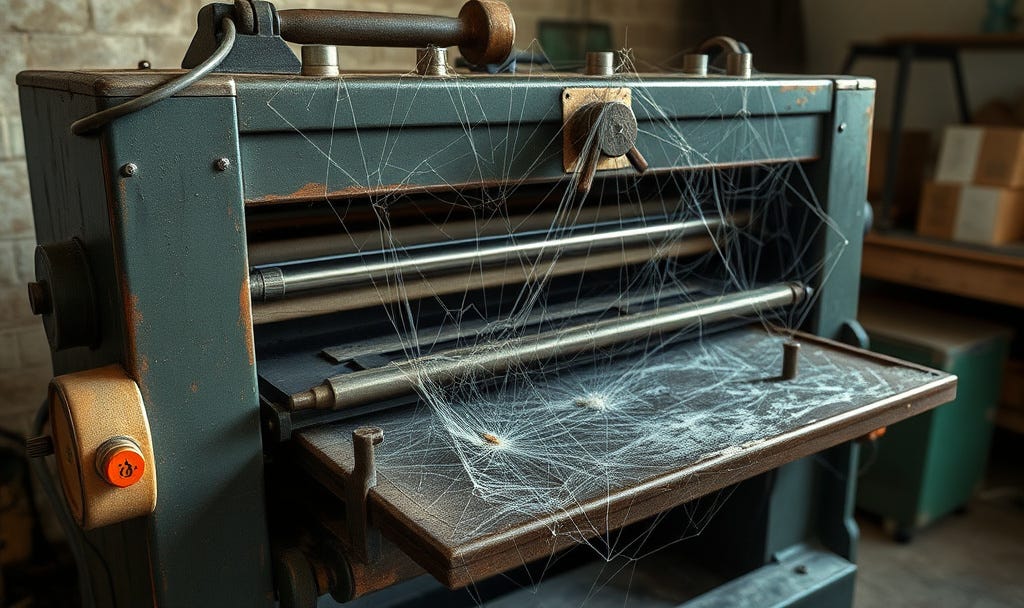
“I really wish someone would open a print shop in town,” she said in a room full of socialites.
I miss our local print shop too. I will admit, I did not use it as often as I could have. Being partially in the industry myself, I had other avenues for production. But from time to time I would place an order and walk into that shop on Market Street.
They retired, well earned after years of dedication and hard work serving our community. Running a print shop is not easy. Last-minute changes. Alignment issues. Typos discovered after the proof was approved. Customers who want one more tweak. I often wondered if that prompted the sign behind the counter with a cowboy pointing a revolver and the caption, “Go ahead, make one more change.” My kind of humor.
It would be easy to assume the closure was simply retirement. Perhaps it was. But in this industry, margins are thin and patience thinner. I heard it often: “I found this place online. It was really cheap.” Or, “I don’t go there anymore. They messed my project up.” Rarely do we revisit the proof with our own signature on it and admit that some mistakes are shared.
Online vendors can be cheaper. They can also be faceless. If something goes wrong, you email a ticket into the void. When something went wrong on Market Street, you walked back in the door and talked to someone who knew your name.
We talk often about supporting local businesses. We believe that buying a cookie at the neighborhood coffee shop means we have done our part for the month. I am sure they appreciate the sale. But one cookie does not cover rent, payroll and utilities.
Imagine handing out miniature candy bars on Halloween and declaring you have ended world hunger. It is generous, but it is not sustainable. Businesses require more than occasional goodwill. They require habit. Consistency. A decision to return even when it might cost a few dollars more.
Older generations talk about when downtown flourished. Part of that was necessity. Fewer options. Fewer roads leading elsewhere. The internet did not exist. Our phones were not portals to endless vendors across the country. Today we are overburdened with choice. We can drive an hour for detergent or order custom business cards at midnight from a warehouse three states away. “Have it your way” comes with a hidden cost.
Will there ever be another print shop downtown? Maybe. But it will not survive on nostalgia alone.